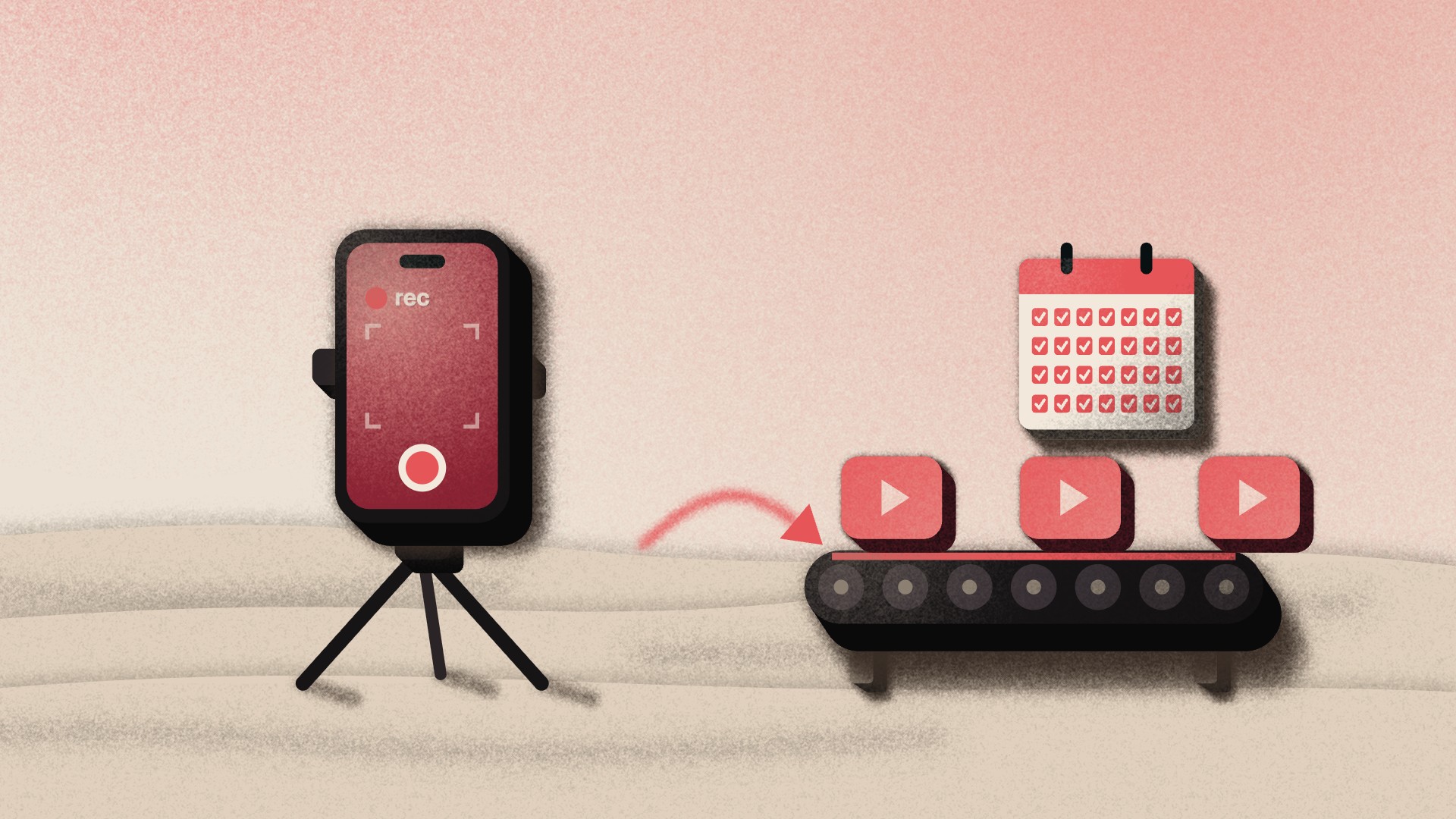
You know your business should publish. But there is no marketing team, your days are full, and you may not want to be on camera. Founder-led content needs none of those. It needs one face your buyers already trust, and that can be you or someone on your team. It needs the questions buyers already ask, two people who publish one answer every day, and a scoreboard that counts buyers, not views. By the end of this article you'll have the five steps in order, a three-question test for who your face should be, and the one question that shows which videos bring in buyers.
The engine is five steps, and none of them needs a marketing hire
Do them in this order. Each step needs the one before it. A line with no face has nothing to film, and a daily schedule with no list of questions runs dry.
Step 1: Your face is the person buyers already trust, and it doesn't have to be you
What to do. List three people who talk to buyers: you, and the two others buyers ask for by name. Put each one through three questions. Does this person explain your work clearly to a buyer? Will they likely still be with the business in three years? Can they give half an hour a day to the camera? Cast the first person who passes all three, and name a second as back-up. Then write down how your face really talks: their usual phrases, their pace, the examples they always reach for. Script nothing beyond that.
One owner asked it this way: "Should I start to do social media for my business on my personal profile or a dedicated one?" The test above answers it. Publish under the name of the person you cast. Our view: a named face matters more than which account it sits on.
How you know it worked. Within a month of daily answers, new enquiries mention your face by name.
Why. In many businesses, trust already sits with someone. Customers ask for them on the phone and name them in reviews. Putting that person on camera extends trust that exists, instead of building it from zero.
Example. Wendy's made its founder, Dave Thomas, its TV spokesperson in 1989 1. He was not a natural actor, and his early ads came across as stiff 1. The ad agency then built humour around his own folksy, self-deprecating manner, and he fronted Wendy's ads until his death in 2002, more than 800 of them 12. Wendy's says a company survey in the 1990s found that 90% of Americans knew who he was 12. The lesson: write for the person you have, not the presenter you wish you had.
Step 2: Every topic is a question a buyer already asked
What to do. Start one shared list called "questions buyers asked". Everyone who talks to buyers adds to it: sales, support, whoever answers the phone. Write the buyer's exact words, not a tidy version. Sort the list so three kinds come first: questions about price, comparisons with other options, and the problems your best customers had before they bought. Each question becomes one answer for one day.
How you know it worked. Buyers start calls with "I watched your video about…" and skip the basic questions.
Why. Buyers search for answers to their own questions, in their own words. Answer the ones that come right before a purchase, and you meet buyers while they are choosing.
Example. After the stock market fell in October 2008, River Pools & Spas, a pool company in Virginia, was hit hard 3. Its CEO, Marcus Sheridan, listed the questions buyers asked him and turned them into article titles. The first one answered "How Much Does a Fiberglass Pool Cost?" 3. Half of the most popular search terms that brought visitors to the site were about cost 3. He later wrote the method up as a book, They Ask, You Answer 4. The full case is below.
Step 3: Two people run the line when the face only does the talking
What to do. Name two roles. The face records answers. A producer does everything else: cuts, titles, posts, tracks links and handles replies. The producer can be someone already on your team for part of their day, a freelancer, or one person editing with AI tools. Set one rule for approvals: the only check before posting is a fact check. Everything else ships.
How you know it worked. The face spends under 30 minutes a day on it, and nothing waits on them except the recording. A harder test: if the face took two weeks off, the line would keep publishing from answers already recorded.
Why. Filming is a small part of the work. Around it sit editing, titles, posting, replies and sign-offs, and when the face does all of it, the face stops. A marketing department can make this worse with approval rounds and polish, while 65% of hidden buyers in one large survey prefer "a more human, less formal tone" 56.
Example. Blendtec started its videos on almost no budget. In October 2006 its marketing director, George Wright, spent $50 on props, including marbles, a rake and golf balls, and put CEO Tom Dickson on camera blending them 7. Blendtec says retail blender sales rose 700% within two years 78.
Step 4: Publishing daily on a fixed set turns answers into a show
What to do. Fix the set: the same spot, the same light, the same first line, such as "Here's a question a client asked us." Record several answers in one sitting if that suits your face, then publish one every day. Start on one main platform. Add others only once the daily rhythm has held for a month.
How you know it worked. For 30 days in a row, an answer went out, and the face never had to think about how to start.
Why. Daily answers stack up, and each one is another chance for a buyer to find you. The same person in the same place with the same opening is easy to spot in a feed, the way a show is.
Example. Large advertisers build whole campaigns on a recurring character. Progressive has run Flo, a fictional salesperson played by the actress Stephanie Courtney, since 2008, in more than 100 ads 914. The ads change. The character stays.
Step 5: The scoreboard counts buyers, because views send the wrong signal
What to do. Add one question to every enquiry form and every first call: "Have you seen any of our videos? Which one?" Write the answer next to the lead. Put a tagged link under each video and say the next step inside it, so you can see which video sent the click. Once a month, rank your videos twice: by views and by enquiries. Make more of whatever tops the second list, even if its views were small. Where you have no answer, write "unknown", not zero.
One person asked how to do the maths when customers come "organically, no marketing team, no ads". This question starts that maths.
How you know it worked. You can name the three videos that brought in the most enquiries last month.
Why. The videos with the most views may sell nothing. A broad, fun answer can travel far among people who will never buy, while a plain answer to a narrow buyer question reaches fewer people and more of the right ones. Views tell you what the platform rewarded. Enquiries tell you what your buyers wanted.
Example. River Pools tied reading to buying, as the case below shows.
Why it works: buyers judge your expertise before they call, so the face starts the sale for you
Many buyers now judge you without talking to sales. In the 2025 Edelman-LinkedIn report, a survey of 1,934 executives, 71% of "hidden" buyers reported little or no contact with sales reps 5613. These are often the finance, legal and operations people inside a buying group 613. In the same survey, 64% said they trust thought leadership, a supplier's expert content, more than its marketing material or product sheets, and 55% to 56% use it to build their shortlist 5. More than half said a known brand matters less when the expert content is good 5. The survey is large but vendor-run, so read it as a strong signal, not proof.
Here is the mechanism. A logo can't show judgement. A person answering a hard question in plain words shows it in a minute. By the time the buyer calls, they have had something close to a first sales call with your face.
The usual advice on founder content gets the goal right and stops in three places. It assumes the founder must be on camera. It judges success by views and followers. And it often makes the founder the whole content team.
The owner pays an agency or a marketing hire to post about the business, and judges it by followers.
One trusted face answers buyers' questions every day, two people run the line around them, and every enquiry is asked which video it saw.
This is the first rung of the media ladder: moving from "the business posts now and then" to "a named person speaks for it".
The part most advice skips is who that person must be. The trust attaches to the person on screen and the role they play. It does not have to attach to the founder. Lee Iacocca did not found Chrysler. Chrysler hired him in 1978, he became CEO in 1979, and he fronted its ads through the 1980s with the line "If you can find a better car, buy it" 10. Colonel Sanders sold Kentucky Fried Chicken in 1964 and stayed on as its paid brand ambassador 1115. Decades after his death in 1980, Decades after his death in 1980, KFC brought him back in 2015, played by comedian Darrell Hammond 11. And Flo is an actress playing a salesperson 9.
So the face is a role you cast. It can be you. It can be the engineer who explains things best, or the account manager clients already ask for by name.
Worked case: River Pools ran all five steps, in writing first
River Pools shows all five steps in one business: a pool company in Virginia, hit hard by the 2008 crash 3.
- The face. Marcus Sheridan answered the questions himself, in writing 3. Writing is a fair start for a face who isn't ready for the camera.
- The questions. He listed the questions buyers asked him and turned each one into a title, starting with cost 3.
- The line. The answers lived on the business's own website, where any buyer could find them 3.
- The rhythm. The site grew big enough for a buyer to read 30 pages of answers 3.
- The scoreboard. He tracked analytics for every post and tied reading to buying. Visitors who read 30 pages bought a pool 80% of the time on sales calls 3. One post listed the five best pool builders in Virginia and left out his own business. By his count, it brought in $150,000 in sales 3.
PR News reported that River Pools became the number one pool manufacturer in Google search results 3. The same method works on video. The question list, the face and the scoreboard stay the same. Only the format changes.
Limits: founder-led content fails when the back-up, the buyers or the offer is missing
Check these before you commit a year to it.
The evidence is mostly self-reported. The buyer survey is large but vendor-run 5. Blendtec's 700% is the company's own figure 78. Marcus Sheridan's $150,000 is his own count 3. We found no study that links founder content directly to revenue. Treat every case, these included, as a reason to test, not a promise.
The face can leave. The blunt version of this fear, as one person put it: "How are you going to replace yourself when you are the face of the brand…" If the whole engine sits on one person, you have built a new dependency. The fix is to build the role as well as the person, and to keep the back-up face from step 1 appearing now and then. State Farm shows a role can outlive the person who started it.
Your buyers may not watch. One owner who sells to dentists put it this way: "they say dentists are not on social media." Before you start, check where your buyers already look for answers. If they don't watch video, the same questions still work as articles, emails, or answers you send before a quote.
A trusted face can't fix a weak offer. Iacocca's ads ran alongside new cars, the K-cars and the minivan, and his reforms at Chrysler 10. A trusted face brings buyers to the door. What they find inside still decides the sale.
Some faces can't do the camera yet.
I'm horrible at camera work and just being on camera in general.a business owner
That owner turned to animated ads instead. Writing is another fair first step, and River Pools began in writing 3. Or cast someone else on the team. The rule is that a recognisable person stands behind the answers, in a format they can keep up every day.
Do this week: your reviews will tell you who your face should be
You don't need a new tool or a new hire to start. You need one hour with your reviews and your inbox.
The review-name tally (one hour)
If no name appears in 30 reviews, that is a finding too. Buyers are trusting your logo alone, and nobody speaks for the business yet.
You now have an engine that needs no marketing team
You started with no marketing team, no spare time and maybe no wish to be on camera. Here is what you have now.
- The five steps, in order: cast the face, fill the question list, build a two-person line, publish daily on a fixed set, count buyers. The team is two roles, not a department.
- The face test: knowledge, staying power, and half an hour a day. The face can be you or someone buyers already trust, so the camera is a choice, not a sentence.
- The buyer question: "Have you seen any of our videos? Which one?" on every enquiry, so you judge each video by who it brought in.
Read next: finding your business's point of view, the things you believe that competitors won't say. Then your first ten videos, and what makes buyers believe you when anyone can publish with AI.
Related: if you are the face today and want to step back later, read how to replace yourself in your business. To turn the two-person line into a system your team runs without you, see how to build systems your team actually uses. If AI will do your editing, read your AI agents are busy, not useful first.
Your position: the Media rows of the Scorecard, "M-1 A face and a voice" and "M-2 Volume system", show where your business stands today.
Sources
- Dave Thomas (businessman)) · Wikipedia
- Dave Thomas · Biography.com
- To Save his Business Marcus Sheridan Became a 'Pool' Reporter · PR News, 6 September 2012
- They Ask, You Answer · Marcus Sheridan
- Report: Over 40% of B2B deals stall due to hidden buyers (Edelman-LinkedIn "Invisible influence", 1,934 executives) · Marketing-Interactive, 27 June 2025
- Why B2B marketers need to rethink thought leadership for the hidden buyer era · ContentGrip, 2025
- Will It Blend? · BYU Magazine, Spring 2009
- Mashup: 200 PR Execs, One Blender · ClickZ, 12 September 2008
- Flo (Progressive)) · Wikipedia
- Lee Iacocca · Wikipedia
- Colonel Sanders · Wikipedia
- Jake from State Farm · Wikipedia
- Thought Leadership or Brand – Which Matters More to "Hidden Buyers"? · CustomerThink, 2025
- Watch Progressive's 100th ad with Flo · Cleveland Scene, 10 November 2014
- 7 things you didn't know about Colonel Sanders · Fox News
- State Farm TV spot, "Batman v. Bateman: Fanny Pack" · iSpot.tv, 2025