If your business still waits on you for the work, the checks or the decisions, you are at a level, and in our model each level has one next move. The short answer, in our view: your level is set by what still runs through you, not by your revenue or by how hard you work. By the end you'll have three things: the five levels and the test for each, your level in each of operations, technology and media, and the one move that gets you to the next level.
You can find your level by what still runs through you
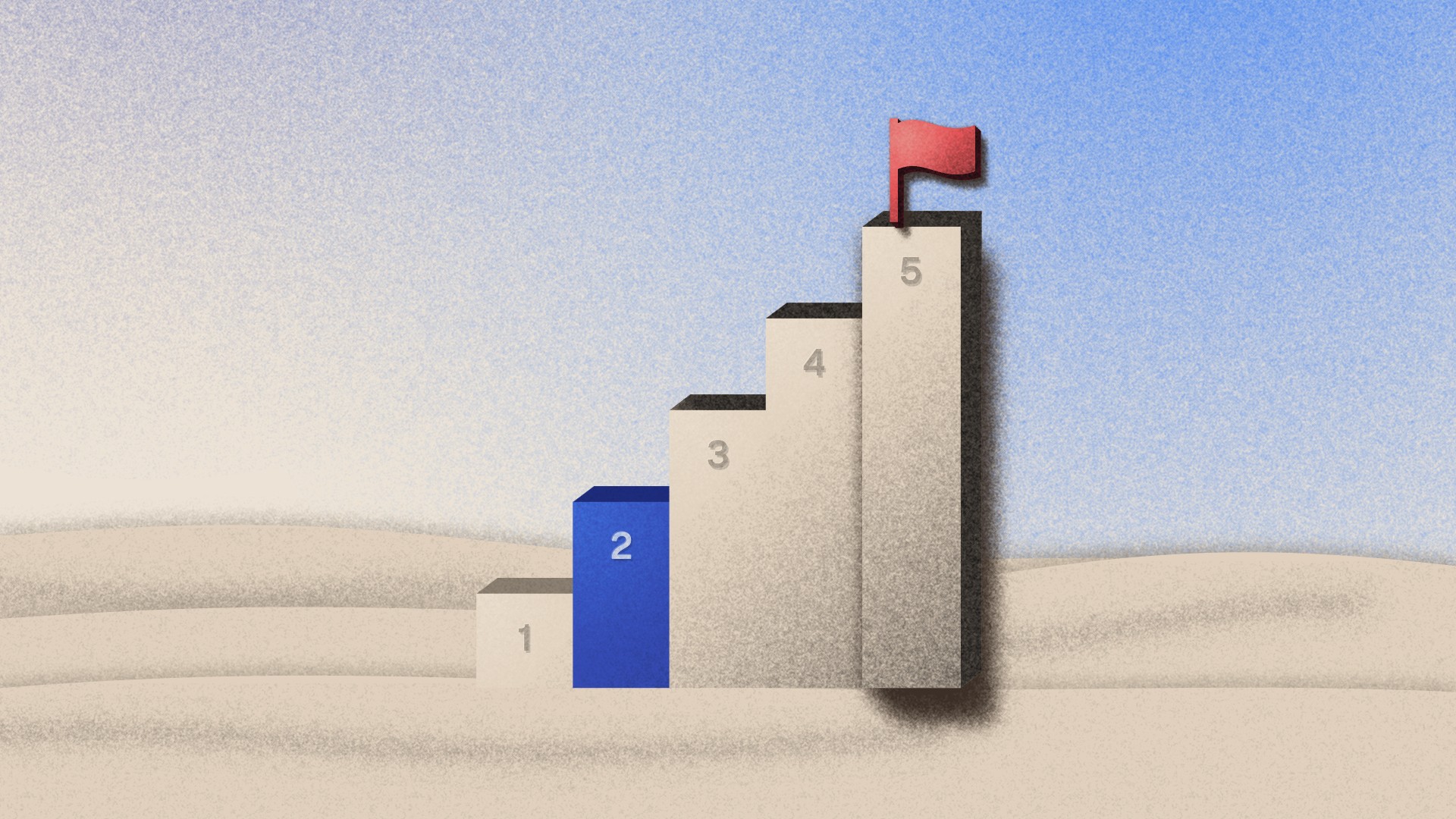
Our five levels sort an owner-run business by what still runs through the owner: the work, the checks, the know-how, the decisions, and finally the growth. The five levels are: one, everything runs through you; two, you check everything; three, the work is written down; four, the work is owned by the team; five, the business runs and grows without you. One reader put it this way: "Everything must have a special name in business books." That is why our levels are plain sentences you can check against your own week, not new terms to learn. Read your level, the one before it and the one after it; the rest doesn't apply to you yet.
How much of the business still runs through its owner: the work, the checks, the know-how, the decisions or the growth.
Our quickest test is absence: picture a set stretch of time away from the business and ask what would stop. Answer for a normal month, not your best or your worst one. Work down the questions below and stop at the first no; that no is your level. This is a self-estimate; the two-day test at the end of this article checks it against what really happens.
Each level below has three parts: how to tell you're there, the one move to the next level, and how you'll know the move worked. In our view, a level map only helps if every level has its own picture of what being there looks like, so each level below gets its own.
Level one: everything runs through you, so hand off the work that repeats
Do this. List the work that comes back every week, such as orders, invoices and customer replies, and give the largest piece to one person who owns it from start to finish.
It worked when that work gets done every week without you doing it, even if you still check each piece.
Why. In our model, you're here if a week away would stall sales or delivery, because you still do the work yourself. One owner who has run an online store alone for two years put it this way: "I'm handling everything: sourcing, inventory, customer service, shipping, social media, and somehow still trying to sleep." Our rule of thumb is to start with work that repeats, because it gives back time every week once someone else owns it.
Example. Our rule of thumb is that the person should own the whole piece of work, not single tasks you hand out each day.
The full method for this move: How to Replace Yourself in Your Business (Before You Can Afford a Team).
Level two: you check everything, so write down how the work is done
Do this. Write down first the few processes that bring in money, in steps someone else can follow, and answer each new question by adding it to the steps instead of only giving the answer.
It worked when someone new can run one of those processes from the written steps without asking you.
Why. In our model, you're here if your team does the tasks but you approve the work, and two weeks away only works with daily check-ins. One person put it plainly: "Why am I paying just to have to micromanage?" Our rule of thumb is that a process that only works when one person runs it is not a process yet.
Example. One person put it this way: "Lost a key team member last month and realized how much was just in her head." We read that as the risk of staying at level two: when the know-how lives in people's heads, it leaves when they do.
To make the team use the written steps: How to Build Systems in Your Business That Your Team Actually Uses.
Level three: the work is written down, so decide who decides
Do this. Write the decisions your team can make without you, each with its limit, such as a spending cap, a discount ceiling or a refund rule, and stop approving anything that falls inside those limits.
It worked when decisions inside the limits get made while you're away, and you hear about them afterwards, not before.
Why. In our model, you're here if recurring work runs from written steps and two weeks away works without check-ins, but the decisions still wait for you. One owner of a business with 45 employees put it this way: "I find it very hard to really give myself space for strategy thinking." Our rule of thumb is that written steps come before handed-over decisions, because people decide better when they can see how the work runs.
Example. In a field experiment with large Indian textile firms, Nicholas Bloom and colleagues found that adopting modern management practices raised average productivity by 11% 1. The same study found that the practices increased decentralization, "as better information flow enabled owners to delegate more decisions to middle managers" 1. We read that as support for this order: first make the work visible, then hand over the decisions.
Level four: the work is owned by the team, so let technology take the measured work
Do this. Pick one piece of work your team does the same way every time, write down how you measure it, and hand it to a tool or an AI agent while a person checks the results against that measure.
It worked when the work holds the same measure for a full month without adding a person to do it.
Why. In our model, you're here if your team decides within limits and a month away works, but growth still means hiring more people. In our view, at the top levels technology does the repeatable work and people keep the judgment: strategy, relationships and leadership.
To judge whether the tool or agent is working: Are the AI Agents in Your Business Useful, or Just Busy?.
Level five: the business runs and grows without you, so keep it there
Do this. Write the rules your team uses to start new work and to stop work that isn't paying off, and review those rules on a fixed date each quarter.
It worked when you can be away for two months and the numbers hold.
Why. In our model, you're here if the team starts and stops work on written rules without you, and your role is to set direction and check the rules. One reader of a business book put it this way: "I run a small law firm and relish the idea of stepping away to pursue bigger dreams." In our view, level five is what that wish needs: the owner can step away and the business keeps running and growing.
Your level can be different in operations, technology and media
Our levels run across three parts of the business: operations, technology and media. In our view, you can be at level three in operations and at level one in media, and the lowest of the three can hold the other two back. Find your level in each column of the table below, then start with your lowest one.
| Operations | Technology | Media | |
|---|---|---|---|
| Level one: everything runs through you | The business runs through you | Technology is someone else's job | Nobody knows you exist |
| Level two: you check everything | Your team does tasks, you approve everything | Lots of tools, no system | You promote now and then |
| Level three: written down | Recurring work runs from systems | You judge and choose your tools | You have a voice and use it |
| Level four: owned by the team | Your team decides within limits | AI does measured work | You publish at volume |
| Level five: runs and grows without you | The team ships and kills on its own rules | You grow without matching headcount | You lead your category |
On our Scorecard, your overall level is the average of the three pillars, rounded, and the result names your lowest pillar and the item to work on first. If media is your lowest pillar, work on it at whatever level the rest of your business is at.
For media at any level: Founder-Led Content: How to Build a Media Engine Without a Marketing Team.
Revenue doesn't set your level; what still runs through you does
In our view, revenue and level can come apart. One person replied: "At that revenue, the bottleneck isn't sales anymore it's that everything still runs though you." We read that as the core of this model: sales can grow while the owner's role stays at level one.
Harvard Business Review lists Churchill and Lewis's "The Five Stages of Small-Business Growth" in its May 1983 issue 2. As an open textbook summarises it, Churchill and Lewis's 1983 Harvard Business Review article identified five stages of small business growth: existence, survival, success, take-off and resource maturity 3. In the existence stage, as an open small-business textbook summarises Churchill and Lewis, the owner does everything, directly supervises a small number of people, and systems and formal planning do not exist 3. In the survival stage, the same summary says, little systems development is evident and "the owner still runs everything" 3. At take-off, the summary names two key questions: "Can the owner delegate responsibility to others to improve managerial effectiveness?" and "Will there be enough cash to satisfy the demands of growth?" 3. At resource maturity, the summary says, "The owner and the business have separated both financially and operationally" 3. In our view, those stages turn on what the owner still does and what the owner hands over, which is what our levels measure too.
You measure the business by revenue and treat the next level as more sales.
You measure the business by what still runs through you, and the next level is one thing you stop doing yourself.
Harvard Business Review summarises Larry Greiner's article "Evolution and Revolution as Organizations Grow" in one line: "Management practices that work well in one phase may bring on a crisis in another" 4. Greiner first proposed his growth model in 1972 with five phases; a sixth phase was added in 1998 5. In Greiner's model, growth through creativity ends in a crisis of leadership, growth through direction in a crisis of autonomy, growth through delegation in a crisis of control, and growth through coordination in a crisis of red tape 5. In Greiner's direction phase, as summarised on Wikipedia, decision makers are overloaded with work, and growth encounters a crisis of autonomy 5. We read Greiner's point as the reason a level can trap you: the habits that got the business here can be the ones the next level asks you to change.
In our view, the usual answer to feeling stuck, more effort or one big hire, often fixes the wrong problem. We think moving up a level changes what you do, not how hard you work; the way out is a decision about your role. Our rule of thumb is that each level has one constraint that matters most; fix it and the next one shows up somewhere else. In our view, when the problem moves, that is progress: the business has outgrown the old one. We also think a business that needs you for everything is not safer for it; it is stuck.
Research links growth to delegation, and holding on can end badly
Harvard Business Review's page for Greiner's article describes the key executives of a retail store chain who hold on to an organizational structure long after it has served its purpose, because the structure is the source of their power; the company eventually goes into bankruptcy 4. We read that as a level trap at a larger scale: a structure that worked in an earlier phase was kept because it served the people at the top.
Gallup reported in 2015 that only one in four employer entrepreneurs have high levels of what it calls Delegator talent 6. Among 143 Inc. 500 CEOs Gallup studied in 2014, those with high Delegator talent posted an average three-year growth rate of 1,751%, 112 percentage points more than those with limited or low Delegator talent 6. Gallup also found that those CEOs generated 33% more revenue in 2013, $8 million against $6 million 6. In Gallup's 2014 study of 1,446 U.S. employer entrepreneurs, 33% of those with high Delegator talent planned to grow their business significantly, against 21% of the rest 6. Gallup adds that business success and growth "aren't exclusive to entrepreneurs who are highly talented at delegating" 6. We read those numbers as a link between delegating and growing, not proof that one causes the other.
Bloom, Sadun and Van Reenen collected data on how decisions are delegated from headquarters to plant managers in almost 4,000 firms in the US, Europe and Asia 7. They found that trust and the rule of law "appear to facilitate delegation", and that areas with higher trust "allow more efficient firms to grow in scale" 7. That finding measures trust and the rule of law where firms operate, not inside them; in our view, written steps and limits do a similar job inside a business.
One team felt the strain at ten people, but research gives no fixed size
One person whose team had grown from five to ten put it this way: "When we were a team of 5, everything ran smoothly. Everyone knew what they were doing, communication was easy, and if something went wrong someone would just fix it. We did not have a lot written down because we did not need to. Everyone was in the room. Now we are at 10 and it feels like a different company." The same person added: "The worst part is I am becoming the bottleneck. Every question routes to me because I am the only one who knows how everything is supposed to work." In our model, that is the move from level two to level three: the work that lived in people's heads has to be written down.
In 2005, Zhou, Sornette, Hill and Dunbar, analysing published studies of human social groups, found preferred group sizes in a series approximating 3–5, 9–15 and 30–45 8. A 2021 re-analysis in Biology Letters found such wide confidence intervals for a human group-size limit that the authors concluded "specifying any one number is futile" 9. The same paper notes that "Dunbar's number", a widely believed limit of about 150 stable relationships, comes from extrapolating a regression line relating neocortex size to group size in primates 9. We read that as a warning against any rule that says a business breaks at a set size; watch what routes through you instead of counting heads.
You don't have to climb to level five
In Churchill and Lewis's success stage, the textbook describes two tracks: an owner who risks all resources to finance growth, or one whose operational duties are taken over by managers, with the focus on the status quo 3. The same textbook notes that the growth stages will not apply to all small businesses, because not all small businesses are looking to grow 3. In our view, a steady business at level two or three is a sound choice if you made it on purpose, and the moves above still help you hold it with less of your time.
One owner who has run a service business alone since 2005 put it this way: "I’m getting too old and tired to keep doing it all on my own." If that's where you are, the first move is still the level-one move: hand off the work that repeats, whether or not you want to grow.
The SBA's Office of Advocacy counts 36,207,130 small businesses in the United States, 99.9% of all businesses 10. According to the Census Bureau's 2022 Nonemployer Statistics, 29,811,495 U.S. businesses had no paid employees 11. The Census Bureau's 2022 County Business Patterns show that 55.7% of U.S. employer establishments had fewer than five employees 11. Of the 677,876 private-sector establishments that opened in the U.S. in the year ending March 2015, 79.6% were still open a year later, 50.2% after five years and 34.6% after ten years, according to the Bureau of Labor Statistics 12. In that same group, the average employment was 4.4 at opening and 11.8 among those still open ten years later 12. We read those numbers as a reason to hold any level map loosely, ours included: it describes businesses that grow, and many U.S. businesses have no employees at all. We know of no public count of owners by level, so this article doesn't say which level is the common one.
Take two working days away within the next fourteen days and see what stops
One person who bought a 50-year-old business explained the slow periods in its bank statements: "The business wasn't slow, he just wasn't there." The same buyer on the seller: "He ran it on instinct for 50 years and had no idea what he actually had." Our rule of thumb is that what stops while you are away shows your level better than any score. The test below takes two working days and three numbers.
the two-day absence test
You now have your level, your lowest pillar and your next move
You started with a business that still waits on you for the work, the checks or the decisions. You now have the five levels and the test for each: what still runs through you, checked by the questions and the two-day absence test. You have your level in each of operations, technology and media, and you know to start with the lowest. You have the one move to the next level, and where one exists, the article that goes deeper.
Read before: You Read the Business Books. Why Didn't Anything Change?. Read next, by your level: level one, How to Replace Yourself in Your Business (Before You Can Afford a Team); level two, How to Build Systems in Your Business That Your Team Actually Uses; level three, How to Stop Micromanaging Your Team: Delegate Decisions, Not Tasks; level four, Are the AI Agents in Your Business Useful, or Just Busy?.
To place yourself on all twelve rows across the three pillars, take the Operator 2030 Scorecard.
Sources
- Does Management Matter? Evidence from India · NBER Working Paper 16658 (Bloom, Eifert, Mahajan, McKenzie & Roberts), January 2011
- The Five Stages of Small-Business Growth · Harvard Business Review (Neil C. Churchill and Virginia L. Lewis), May 1983
- 1.3 Evolution, Small Business Management in the 21st Century · Saylor Academy open textbook, summarising Churchill & Lewis (1983)
- Evolution and Revolution as Organizations Grow · Harvard Business Review (Larry E. Greiner), May–June 1998 (first published 1972)
- Larry E. Greiner · Wikipedia, section "Greiner's growth model", read November 2026
- Delegating CEOs Grow Faster · Gallup (Sangeeta Bharadwaj Badal and Bryant Ott), 14 April 2015
- The Organization of Firms Across Countries · NBER Working Paper 15129 (Bloom, Sadun & Van Reenen); Quarterly Journal of Economics, 2012
- Discrete hierarchical organization of social group sizes · Proceedings of the Royal Society B (Zhou, Sornette, Hill & Dunbar), 2005
- 'Dunbar's number' deconstructed · Biology Letters (Lindenfors, Wartel & Lind), May 2021
- Frequently Asked Questions About Small Business 2026 · U.S. Small Business Administration, Office of Advocacy, 3 February 2026
- Small Business Week · U.S. Census Bureau, May 2025
- Business Employment Dynamics, Table 7: Survival of private sector establishments by opening year · U.S. Bureau of Labor Statistics, read November 2026